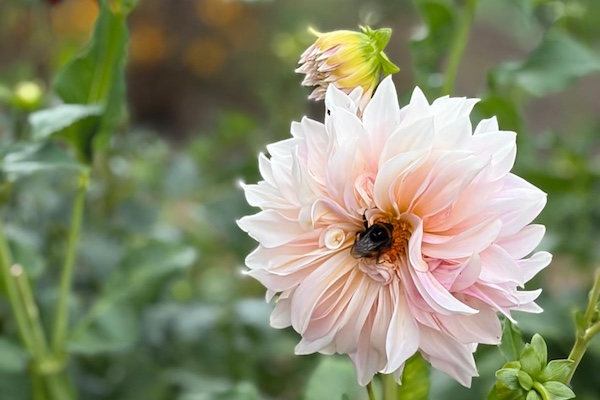

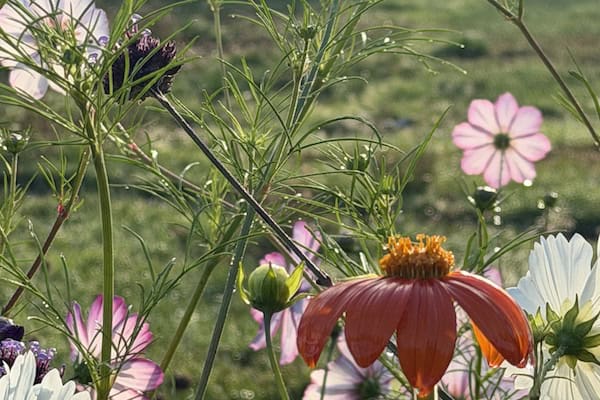
What actually makes a cottage garden a cottage garden? In this episode, I’m talking to Clare Foggett, editor of The English Garden, about her new book exploring the history, abundance, and individuality of this much-loved style. We ask whether its relaxed, plant-packed approach might also have something to teach us about sustainable and wildlife-friendly gardening.
What You’ll Learn in This Episode:
-
The true history and defining characteristics of traditional British cottage gardens
-
How to combine flowering perennials, edible crops, and structural plants
-
Why dense, informal planting benefits local wildlife and biodiversity
-
Modern ways to adapt cottage garden principles for sustainable gardening
Benny’s Insect of the Week: Ivy Bee
Cottage Garden History, Design & Wildlife Benefits
Clare Foggett explores how British cottage gardens evolved from practical, food-producing spaces into iconic ornamental designs. We examine how a relaxed planting style reduces soil disturbance, creates rich micro-habitats for beneficial insects, and provides inspiration for modern, eco-friendly plot design.
Featured Links & Resources
-
Book: Beauty & Abundance: British Cottage Gardens by Clare Foggett — Buy on Bookshop.org
Support & Follow Roots and All
-
Support the podcast on Patreon
-
Follow on Instagram @rootsandallpod
-
Follow on Facebook @rootsandalluk
-
Follow on LinkedIn @rootsandall
Related Podcast Episodes from the Archives
If you enjoyed this conversation with Clare, check out these related episodes on cottage style and garden ecology:
-
Episode 168: Cottage Gardens with Andrew Sankey
Andrew Sankey has spent decades researching English cottage gardens. This episode explores what defines the style—including signature plants, planting techniques, and wildlife-friendly qualities—making it a perfect companion guide.
-
Episode 244: The Biodiversity Gardener with Paul Sterry
Paul Sterry explores how gardens contribute to local biodiversity through plant selection, habitat creation, and relaxed management practices that benefit nature.
Sarah Wilson (00:01.56)
This is the Roots and All Podcast. And I’m your host, Sarah Wilson. Join me as I talk about all aspects of garden with some of the top horticulturists from around the world. Hello and welcome to this week’s episode. Today I’m asking what actually makes a cottage garden a cottage garden. I’m talking to the editor of the English Garden, Clare Foggett, about her new book, Exploring the History, Abundance and Individuality of this Much Loved Style.
And asking whether it’s a relaxed, plant-packed approach might also have something to teach us about sustainable and wildlife-friendly gardening.
Clare: When I finished university, I studied English up in Manchester. I didn’t know what I wanted to do, and I faffed about for ages, just doing loads of really bonkers jobs. I worked in a piano shop, I did bar work, I did I was a secretary for ages because I could type quite quickly. and I
Bought my own house up there, and it was just a tiny, tiny little terraced house, but it had the little courtyard at the back, little backyard. And I just started gardening in pots and just, you know, just got the bug, really, really enjoyed it. And yeah, after a few years, I kind of yeah, wasn’t feeling particularly fulfilled in my typing and secretarial work. And one of my friends at the time said, If you love gardening so much, why don’t you pursue that? So
I went to college, I went to Pershore College and studied horticulture. And then towards the end of my years there, saw that the RHS at the time used to do a trainee horticultural journalist position on their members’ magazine. And it was just that kind of really cliched, you know, light bulb moment. And I just thought, yeah, you know, that would combine the English and writing, which I like, and yeah.
So I applied for that and got it and did a year there. And ever since then I’ve worked on gardening magazines and that’s yeah, been my career really. That was sort of twenty four years ago. So quite a long stint. Sounds idyllic. Yeah. I wish they’d have done the RHS journalism thing when I was training, but I kinda went down the design route, but very similar. Someone said to me, Well, what do you like doing? And I just went, gardening and they’re like, Well, do it then I thought, Yeah, okay, crack I will. So
Sarah Wilson (02:18.336)
You’ve got a new book out and it’s about cottage gardens, which we will dig into, pardon pun. But you know, I really do want to get into the sort of nitty-gritty of what a cottage garden is or is not or can be. But before we do that, did you have a kind of particular love of this style of gardening before you put the book together? Yeah, a lot of gardeners do, don’t they? You know, if you speak to people and say, What kind of garden would you like? It’s kind of that
Default answer, isn’t it? Well, cottage garden, because they just, yeah, it’s really hard to define what they are. But in I think in people’s minds they just seem so kind of floriferous and abundant and full of flowers and that sort of the epitome of that joy of gardening that you’re supposed to find. And yeah, I I’ve always loved the style. Was incredibly lucky that the publisher approached me and asked me if I, you know, would be interested in working with them on it. And
Possibly because of the magazine that I edit at the moment is quite traditional. It’s you know, it’s English garden, it’s, you know, traditional styles, quite almost old fashioned. So maybe that’s why they approach me. And yeah. Like you say, I think most people kind of have a small love of cottage gardens, even if that’s not the style that they kind of embrace in their own gardens. And I know you said at the beginning of the book.
You got asked this question a million times, and I am going to ask it again, I’m afraid, but what is a cottage garden?
Clare: It is hard to define. The more I’m asked it and the more I think about it, the sort of more difficult I find it. Because the originals don’t exist anymore. And there’s not really that much in the way of hard evidence of what the originals were like anyway. And I think what’s filtered through to us now is
through the lens of the Victorians who romanticized that original kind of you know bucolic rural idyll and sort of did their own version of it. So it’s a bit like sort of Chinese whispers, isn’t it, from the original to what we’ve ended up with today. And you know, you don’t need a cottage. You can still have cottage garden style planting in, you know, any garden like Great Dixter is one of the gardens in the book.
Because it’s, I think it’s planting is super cottage-y, but obviously Great Dixter isn’t a cottage, it’s an enormous, a sort of manor house. But yeah, I think the conclusion that I came to is if you can sort of add up the sort of space in your garden and the thing that takes up the majority of the space is planting, then you’re probably a cottage gardener. The thing that they all had in common was just this huge passion for plants. And so many of them had started off with.
mostly lawn and some plants, but by the time we featured the gardens, the gardener had just sort of, you know, nippled away at the lawn, got rid of hard landscaping and the thing that was just the overwhelming thing in each garden was lots and lots and lots of really joyous planting.
Sarah: You’ve touched on a few of my questions there, which is do they need to be attached to a cottage? Presumably not because almost all the houses in your book are kind of quite large. And yeah I was surprised to see Great Dixter described as a cottage garden. I was trying to
get to the rationale behind the inclusion of the gardens that you’ve picked. So it is basically about just a lot of plants.
Clare: Yeah, I think so. But that just that style where everything’s crammed in. It’s not necessarily like a you know, like a Piet Oudolf new perennial landscape where I always think they’re they’re beautiful, but quite designed in terms of the planting and where the plants go and they’re in their sways. Whereas a lot of the planting in the gardens in the book is just
People just throwing plants in because they love them. Like the kind of gardening that I think a lot of people just end up doing if you go down to the garden centre and you buy something on impulse and then you just shove it into a gap. But yeah, not necessarily too designed in that way. Like I don’t think anybody would need to do a planting plan to have a cottage garden. You would just, you know, throw everything in and they evolve over time rather than all get planted up in in one go. Like, you know, as if you
we’re designing your garden from scratch. Do you know what mean?
Sarah: Yeah, I do exactly. And I was thinking when I was reading it, you know, these gardens seem to be made rather than designed and they’re very much a kind of an expression of individuality. Yeah, definitely. And everyone sort of has their own take on it. And yeah, this is going back to your first question, if you try and sort of write a list of all the elements that a cottage garden has, or is there a rule or what makes it a cottage garden, everyone’s kind of broken them all. anyway, so it becomes even harder to define. So I originally I thought, I don’t think they have grasses because grasses are a bit newfangled. But then there were gardens that did have a few grasses and they look great. So you know, you wouldn’t think necessarily topery, because topery is quite formal and makes you think of, you know, stately home gardens. But quite a few of them had just little bits of, you know, like a clip box or a bit of clip dew in the corners of borders and
And yeah, not necessarily traditional cottage garden, but didn’t make it not a cottage garden at the same time. Yeah, and is there a trend emerging in terms of the people who put together these spaces in as much as they tend to be female? Yes, actually. Most of them were. Thinking about it, a lot of the garden owners were. Maybe, maybe. I mean, there were some really keen men.
Grafton Cottage in Staffordshire was very much a joint effort between Peter and Margaret, the husband and wife who owned it. And I’d say probably the thing that all of them had in common, regardless of whether they were a man or a woman or was just absolute commitment to their gardens. None of them were low maintenance, you know, we’ll just take a month off gardening and it will be fine, types of gardens. They were all out there all weathers, all year round, super committed, like.
Yeah, labours of love, definitely. Yeah, I mean I can’t read anything into that. It was apparent from reading the book that it tended to be, in most instances, I think, the female of the couple that was driving how the garden evolved, I suppose. Actually, East Lambrook Manor, which I obviously massive manor house, not a cottage, but of course it was the house that was owned by Marjorie Fish, who was the proponent of cottage gardening in the fifties and sixties, and quite famously she
sort of rebelled against her husband because he wanted everything to be neat and tidy and she wanted self-seeders and things spilling into the pass and everything a bit higgledy piggledy. And yeah, she was definitely the driver. And then when he died, ’cause I think he was quite a bit older than her, kind of that’s when she really, really indulged her passion and really went for it and created the garden that, you know, is now English Heritage Listed because it’s such a famous example of cottage gardening. Yeah.
Sarah Wilson (09:18.122)
The other thing that I was playing around with in my head when I was reading it was what is the difference between the cottage garden and because they are attached to big houses and because if you take Dixter, for example, I guess it’s got various different elements to the garden, various different areas, what makes it a cottage garden as opposed to a kind of typical English country garden, which
I don’t know if it’s an an identifiable style either, but that is kind of what I thought a lot of those bigger houses tend towards when it comes to design. I think with Dixter, it’s definitely not all cottage garden. You know, there’s parts of the garden at Dixta that definitely aren’t, you know, the the Topiary Lawn with the meadowgrass I wouldn’t say is very cottagey. The exotic garden at Dixter isn’t particularly, but there’s just parts of the garden that, you know, if you just took them in isolation, they
I feel really, really cottage-y, you’re pushing your way through plants, you know, there’s barely any path left because there’s so much planting. It’s just so abundant and full. And then yeah, I guess the thing that makes a difference is again coming back to that, just generosity of planting. And that’s the kind of dominant feature that really sets it apart is that love of plants and and perhaps at the expense of lawns and huge
patios and areas of paving and gravel and things like that. If it’s plants that you’re really into, then you stand a fighting chance of it being a cottage garden. It’s good because your book really did sort of make me question about what makes me feel a garden is a particular style and the kind of exotic garden at Dixter again is a good example because if you took a jungle garden, you know, the garden at Dixter and a lot of jungle gardens will incorporate things that aren’t necessarily tropical plants, but they are
just fit with that look and feel and it’s like we have this kind of innate sense of what that thing is without always being able to quantify it. Yeah. Yeah. And there are some smaller cottages. Yes, there are. There are. Like little, really cute ones. So that’s good. There are definitely, yeah, yeah. And also I’m guessing the scale of the garden, you know, some of them are quite big, which you tend to think, I think, with cottage gardens historically, that they might be sort of slightly smaller. But I think that’s the thing, isn’t it? It’s this kind of new take.on the cottage garden, which is like you said, a departure from the original whatever that was. Yeah. I mean, if you are the lucky owner of a cottage in the cotswolds, these days it’s not a tiny hovel that you’re gardening to survive, is it? It’s probably quite a desirable, lovely property. Yeah, I’m sure. Well that’s you know the kind of inclusion of edibles, which I guess would have been more of a focus in a cottage garden. How much did you find that they factored in the gardens that you’ve
focused on. Yeah, they’re definitely in the mix. The traditional idea in the cottage garden is that everything was mixed together. So you had your, you know, your runa beans growing in your flower beds. And I just think these days people tend not to do that just for ease of management. And veg patches tend to be separate, don’t they? So you can do your weeding and get in and do your harvesting. Yeah, I didn’t find that so much, but a lot of the gardens did have immense
enviable veg patches and yeah brilliant crops going on but just not necessarily totally mingling together but definitely in the mix in the garden. And are they labour intensive? Because as you say with that amount of plants I’m guessing there’s a real lot of sweat and tears and hard work that goes into them. I would say yeah I don’t think if you want an easy life probably this kind of intensive style isn’t for you. I mean
I say that, but I don’t think that if you have a massive border full of perennials, I don’t think it is necessarily as much work as it can seem from the outside. You know, I’d rather have a border of perennials that I only have to cut back once a year, maybe mulch once a year, than have to mow a lawn every week, you know. I think actually it could be less work, but they’re perceived as more work and I can see where that would be off putting. And then if you want to be the kind of gardener who just
absolutely pursues perfection, then obviously there’s more work you can do. You can go in and deadhead every day. You can make sure there’s absolutely not a single weed anywhere to be seen. So yeah, I think it depends on where you sit on the scale of what you think is acceptable in terms of wildness versus neatness and perfection and but maybe not as hard work as you might think from the outside.
Yes, I agree actually. I I think lawns are just horrible things to maintain, but that’s my personal thoughts. You know, going back to the sort of individuality of them and how they’re sort of expressions of people’s personality, what I particularly liked as well is was the fact that they’re kind of constantly evolving, being edited. They’re like a playground. They’re the kind of place if you love plants that you can keep on changing. And then, you know, that’s brilliant in and of itself because there is the inclusion of annuals and there is the
kind of ability to well a lot of people say they edit and they take things out and then they’ll replace it with something new. So that garden as well is always kind of evolving, which is a really nice exercise in creativity if that’s your kind of thing. Yeah. The thing that actually I hadn’t really thought about in any great depth until I was writing the book. And it was when we went to the Isle of Mull to go and visit Lipne Cloisch, which is Lucy’s Garden on the Isle of Mull. And now just suddenly it dawned on me that actually
Every single garden that anyone creates is just so unique to that person and that place, isn’t it? And you will never ever be able to recreate that garden anywhere else by somebody else. It’s absolutely a product of the place it is and the person doing it. And yeah, on Mull, it was right by the sea. So it was influenced by the sea and salty winds and the climate and Lucy had
She was really interested in sort of southern hemisphere plants that cope really well with that, but she’s also a super forager and she’s always collecting, you know, bits of driftwood and sort of old scrap metal from around the island and repurposing it in the garden. And I just, yeah, I just thought she’s the only person, this is the only place where you’ll ever get a garden that looks and feels like this one. And yeah, absolutely a result of her creativity and fed by
the location and the climate. Yeah, I think that they’ve got that sort of magical element of personality in them. And I can’t imagine, like when you open the book, you just kind of go, I love that garden. I love that garden. I love that garden. You know, there’s not one of them where I kind of went, I really don’t like that garden. But that’s the kind of effect that they have on you. And I don’t know whether that is because you understand them and you read them as that person’s labour of love and it’s just
Kind of beautiful. I I mean, I don’t know anyone who doesn’t like a cottage garden. Have you ever met anyone? No. I don’t think I have, actually. Someone’s now gonna write to me and say, I hate them, they’re horrible. I just can’t stand them, they’re messy, you know. But yeah, generally people just really take to them, don’t they? Well yeah. I mean, even if you don’t necessarily want one outside your own back door, it I mean it’s beautiful photography. Jonathan took some amazing photos, so yeah, very hard not to like them, I’d have thought.
Sarah: They are lovely pictures. And what I liked was that you had the kind of double page spread photos and then you had smaller ones that were like a sort of photo album. I really like that format. I thought that was very clever. Yeah, it worked really well. And you use those little sort the smaller pictures to focus on particular plants, which brings me on nicely to the question of are there kind of quintessential cottage garden plants in your opinion?
Clare: Yes. I think so. Basically it all just comes down to self seeders if we want to be really reductionist about it.
I think all of them, every single one, without exception, had self seeding plants. And that’s one of the things that cottage gardens are known for. But you know, things like foxgloves and centranthers and now probably can’t think of any off the top of my head, but you know what I mean. Just those kind of cottagey annules that just seed everywhere, help make everything look really relaxed and charming and as if it happened by accident and not that much effort went in, even though it probably did. But
Yeah, self seed has definitely just got to have some of those. And then roses, obviously, roses. And there’s kind of slightly nostalgic plants that you remember being in your granny’s garden, maybe like honeysuckle or lupins or lilacs, all those kind of cottage core granny chic kind of things, all help. And you mentioned cottage core, obviously. Yeah. cottage gardens having a bit of a moment. I know you say in the book that
You know, they come in and out of favour and I don’t think they’ll ever go completely out of favour, but are they seeing a bit more of a renaissance? I’d like to think so, because I think they fit in really well with the things that people strive for in gardening now. I very rarely meet a gardener now who still thinks it’s acceptable to squirt insecticide around or use a really noxious weed killer and
Everyone, you know, wants to be more sustainable, wants to be more mindful about the inputs they’re putting into their garden. And cottage gardening perfectly suits that because it is informal and relaxed and you don’t need to blast every weed out of your garden. And Sue at Brick Hall Cottages, you know, her borders were absolutely beautiful, full of her GM collection, but also had dandelions and red campion and other things that, you know, you might have weeded out 20, 30 years ago.
So I think it’s really in tune with how we garden now. And I think a lot of gardens tend to be cottagey in style because of that. And actually, in terms of biodiversity, obviously you had Fowl Bourne’s garden in there, which I’ve never visited, but I absolutely long to. And I think she’s a fabulous example of someone is beautiful, but she’s gardening for biodiversity as well. I mean, are they kind of good for biodiversity, do you think? Yeah, definitely.
Probably solely because they’re just they’re so heavy on flowers. So yeah, they’ve got that ready made supply of everything insects need. And yeah, again, also not too tidy. So you’ve got that messiness and the habitats and things like that. Yeah, and also sustainability inputs, they can be, I think, slightly resource heavy if you were growing a lot of annuals, for example, or you were starting a lot of stuff off from seed, but then
On the flip side of that, like you say, you’ve got the kind of volunteer plants, you’ve got a slightly more naturalistic way of managing it. You’re not using huge great power tools to cut like miles and miles hedge in. You know, that there’s that kind of element. So I suppose they can be quite sustainable. Yeah, I totally agree. And a lot of perennials as well. So we’re all thinking about annual bedding, aren’t we, and how unsustainable it is for town councils to
bed out loads of geraniums and petunias every year and councils are now starting to look to perennials and grasses instead. And a lot of these borders in the cottage gardens are mostly perennials with the self seeders running through them, perhaps with some few well chosen roses or shrubs. So yeah, in terms of new planting and having to produce plants under glass with fertilizers, loads of new compost, it’s just not really necessary for this style.
Sarah Wilson (20:54.602)
No, it isn’t. And I was thinking sort of as a parting question, how do you think that those gardens are faring in this weather? And I know it is like the most challenging year I probably ever gardened in, but how do you think they’re standing up kind of compared to some other styles of gardening? I have been thinking about this a lot actually, and I sometimes look at the book now this year and think, gosh, is this just actually a eulogy to
How gardens used to be, and are we going to be able to make gardens like this in some parts of the country anymore? And yeah, this summer’s super worrying for gardeners, I think, and stressful as well. I would like to think that they probably are quite sustainably planted. A lot of the plants, like red valerian, catmint, roses have surprisingly done okay in you know the hot, dry conditions they’ve remembered.
their roots and where they’re from, like Kazakhstan or wherever they originally came from. So I I mean, I don’t know. I haven’t visited any of these gardens this year. I went to visit them all last year. But actually last summer was hot and dry too. We had browning lawns last summer as well, and they stood up well then. Obviously this summer is a lot hotter, a lot drier. But I would hope that they are coping, hopefully. But yeah, I can’t say for definite. But
I suppose the fact that not many of them have enormous expanses of lawns, ’cause going back to lawns being just the worst thing actually in gardens. It’s your brown lawn that makes everything look a lot worse, isn’t it, when the weather’s like this. I know in my garden, if I just look at my borders, they kind of look okay. They’re obviously suffering, but it’s the area of biscuit coloured lawn in front of them that makes everything look much worse. And because a lot of these gardens have just got rid of the lawn completely, then
They’re probably at an advantage because of that I’d say.
Thanks to Clare for taking us into the history, abundance and individuality of the cottage garden. If you enjoyed today’s episode, you might also like episode 168, Cottage Gardens, with Andrew Sankey, and episode 244, The Biodiversity Gardener with Paul Sterry. You’ll find links to both in the show notes. Before I go, I wanted to let you know that in the show notes you’ll find a link to book tickets to an event that’s happening at Veterans Growth Charity near Hastings on the 2nd of October. We’re extremely lucky to have lifelong ecologist Ian Rumley Dawson given a talk on how to correctly construct bird nesting boxes. So if you’re a wildlife gardener and you like excellent homemade cake, plus you want to have a look around the charity where I work, please do book a ticket. All profits go to support the charity plus it will be an amazing learning experience, so do please buy a ticket and come along if you’re in the area. As always thank you for listening.
Next up is Benny with his insect of the week.
The Ivy bee, scientific name Colites Hederae. So my insect of the week this week is the ivy bee, a wonderful species, which has colonized the UK at a rapid pace. It’s now also colonized Ireland, moving northwards. So really nice to talk about kind of positive stories of insects and things doing really well on our shores. So if we start with the etymology
The genus Calites comes from ancient Greek meaning a cementer or plasterer. And this relates to the the cellophane like line in of the brood cells. So if you sometimes see like a bank where they’ve been nesting exposed from the wind or erosion in the winter, you can sometimes see these little cellophane like cells where the the bees have hatched out of. I think it’s more to do with remaining
moist or or adequately moist. So desiccation is more of a risk than flooding or inundation. I was told by the great Andy Phillips, as always. And so these this kind of group of bees, the Calites genus, often known as plasterabes. I think that’s more of an American term, but I think even in the UK. Calites heterae. So heterae, if you’re a plant lover, as many of you are, comes from hetera.
Latin relating to ivy and ivy for this species is the main source of pollen. A study with Dave Gorson, like a pollen analysis study, Dave Gorson was one of the the authors, showed in the UK it was ninety eight point five percent pollen collected from ivy species. they even think, you know, the one point five percent, some of that was even just contamination, so it may even have been slightly higher.
There was a piece of research that Olivia Felipe mentioned at the Bef Chatter Symposium recently about IV bees in southern France or in Europe collecting pollen from other plants. Quite interesting to see how their behaviour might change. But the UK and Ireland is all the research we have has a very strong and close association with Ivy. And so we’re
In September now, and kind of key flowering window of ivy. And so this species is one of the exceptions to the rule that most solitary bees in the UK are kind of done by August. There’s a couple of exceptions. C aster mining bee, the ivy bee, the parasitic bees that utilize those as their hosts. But then you’re just talking about kind of common bumblebee species and honey bees. So it’s nice to have some solitary bees still knocking about this time of year. This species colonized the UK.
For mainland Europe about two thousand and one. Took another twenty years for it to colonize Ireland, as far as I can see on the record. So two thousand and twenty-one for Ireland. And this made it up the up the UK at a rapid pace and it’s in Scotland now. You often see that mass aggregation of nesting. So sometimes people think it’s a swarm, but it’s not. These are still solitary bees, they’re still female actually on their own to collect the pollen on their own provision for their young.
So one female in one hole, usually typically, but you’ll have these big aggregations with hundreds, if not thousands, of bees in the same area. I I every year I get quite excited to receive photos of the species, people question what it is. It’s got beautiful distinct banding, kind of a buffish color banding, alternating with a slightly darker brown. There are very, very similar looking Kaleiti species, so
You can see Calitis bee on ivy, and it’s not a hundred percent guarantee it’ll be the ivy bee. There’s also, for example, the sea aster bee, Calites halophilus, has an extremely close association with our native sea aster plant, which is a beautiful plant. But the wonderful Stephen Folk who wrote the field guys, field guide to the bees of Britain and Ireland, he’s seen Ivy bees on sea acid, and he’s seen sea aster bees on ivy, so sometimes.
You need to give give the give them a close inspection just to confirm the record. But usually this time of year you see lots of IB bees on IB. And you’ll see Siasta bees on Siasta, but that’s not a such a common plant. So they nest in kind of very sunny ground, usually quite sandy, but not always all sand. Free draining can be kind of mounds.
Vertical banks could be imperfect lawns, so people send me pictures of the bee nesting in its lawns. It’s very exciting. solitary bees don’t show aggression like social bees like honeybees and common wasps. So they are typically very, very, very unlikely to sting you unless you were to grab a female. You may get small sting, but I’ve had them in my hands many times and they’ve been very non aggressive. Just want to feed and fly away, provision for their young, that’s it.
So it’s a wonderful species on the wing right now. I hope you’ve seen an ivy bee. If not, obviously look on ivy flowers in the sun. Look for something that’s a bit more fluffy, vivid, and a honey bee, big hairy kind of face, and then the nice striking bands on the abdomen. I will post a picture, but please do record all your sight-ins, try and get the best photography you can, and then upload on iRecord and iNaturalist. You can download or listen to the podcast direct from the website rootsandall.co.uk.
Please also check out my Patreon, where you can make a one-off donation or take out a monthly subscription to help support the podcast. Because if you enjoy the show, please help it continue. I also have a GoFundMe where you can make a one-off donation. Even a one-off donation of £1 helps, and I’ll be really grateful for your support. So please go to Patreon or GoFundMe and search for Roots and All Podcast.
Explore & Support Roots and All
-
💚 Patreon: Support the Show on Patreon
-
📬 Instagram: Follow @rootsandallpod
-
🎧 Subscribe: Available on Apple Podcasts, Spotify, and all major platforms.