
Jon Davies and Steve Williams of Wild City Studio discuss their fresh, unconventional approach to urban horticulture, their collaborative design journey, their experimental playground at Markfield Park, and how embracing a lighter touch can transform rigid cityscapes into thriving ecological havens.
Benny’s Insect of the Week: The Small Copper Butterfly
What You’ll Learn
- Redefining Urban Wildness: How nature-connection and human culture intertwine to make modern cities far wilder than traditional notions suggest.
- Markfield Park Experiments: Insights into using crushed waste substrates, food forestry, and self-seeded corridors for resilient urban landscaping.
- Community-Led Design: Moving away from rigid, sterile design templates to allow local communities and natural processes to shape public spaces.
- Horticultural Rebellion: Why creative outsiders and designers find a new vehicle for expression and disruption through plants and landscape architecture.
Related epsiodes:
Episode 391: Letting the Wild In: This deep-dive archive episode looks closely at how natural ecological processes and spontaneous vegetation interact with modern design choices, matching Jon and Steve’s focus on stepping back from rigid control and letting urban spaces breathe.
Episode 179: Ecological Gardens with Sid Hill: An extensive look into building resilient, nature-led garden systems, directly echoing the punk horticulture ethos and practical structural approaches discussed in this episode.
Key Topics & Discussion Points
What Does Wild Look Like in a City?
Jon and Steve discuss the challenge of finding the right vocabulary to talk about nature connection when humans are inherently part of the ecosystem. Rather than viewing cities as static, controlled environments, they advocate for a light-touch approach that embraces dynamic ecological processes, like weeds breaking through concrete.
Markfield Park: An Experimental Playground
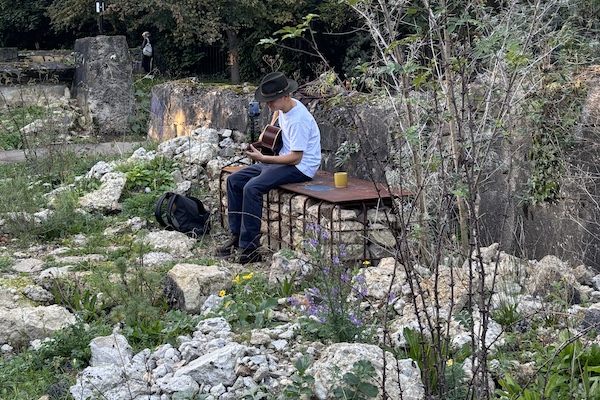
As a legacy project originating from the Chelsea Flower Show, Markfield Park serves as an ongoing test bed for substrate design and food forestry. The duo explains how stepping back from rigid control allowed self-seeders and the local community to collaboratively shape a more vibrant, dynamic landscape.
Letting Go of Design Control
Community engagement is rarely neat or predictable. Jon and Steve share how unexpected interactions with local residents and school groups transformed their original vision into something far more holistic and meaningful. They draw inspiration from international projects like the Groningen project and Paris’s Jardin de Joyo, where self-sufficient natural spaces thrive with minimal human intervention.
Horticultural Rebels and Changemakers
Reflecting on their paths into horticulture from creative backgrounds like art and photography, Jon and Steve explore why landscape design attracts people looking to disrupt traditional systems. Rather than following strict red tape, they encourage gardeners to bring authenticity, passion, and their own unique perspectives to public spaces.
Links & Resources Mentioned
Jon Davies and Steve Williams – Wild City: Punk horticulture for a connected urban future.
You can find more details and purchase the book via the Penguin Random House Wild City Book Page.
Learn more about Markfield Park Community Garden: https://www.markfieldpark.org.uk/
Explore the Roots and All website and archive: https://rootsandall.co.uk/podcast/
Support the podcast via Patreon: https://www.patreon.com/rootsandall
Connect with Roots and All on Instagram: https://www.instagram.com/rootsandall/
Connect with Roots and All on Twitter/X: https://twitter.com/rootsandall
Connect with Roots and All on LinkedIn: https://www.linkedin.com/
What does wild look like in an urban context?
Sarah: What does wild look like in an urban context? Because it’s a funny thing, isn’t it, especially in a sort of very man-made city environment. What is wild?
Jon & Steve: I think that was one of the first things when we sat down to write the book. We’d always been on a bit of a journey together for nearly ten years now, and we were always talking about how we don’t really have the vocabulary to describe what we were talking about.
We’re talking about nature connection, but then again, as humans we are part of nature. So even the language was a barrier. When we sat down to think about how we’re going to talk about this, because the language is weird, the word “wild” seemed to make sense.
It encapsulates far more than just plants or things you might necessarily associate with traditional notions of nature. And that whole idea of the city being wild – if you’re including humans in the frame of nature, then you bring in music, culture, all this stuff. The city itself is far wilder than people would naturally think of it.
A lot of it is about the idea of cities being under a dominant control of the landscape and also the mindset as well. That’s how we’re used to living. So the idea of bringing a wildness back to the city, and back to our own lives and ourselves, is this idea of a light-touch approach where we’re able to just let things be and breathe more.
You can see that in something as simple as weeds growing through the cracks in the concrete, and being able to embrace these ecological processes that are happening in the city. There are lots of spaces around the city where we can embrace those changes, that dynamic rhythm, and open it up to the land, but also in ourselves as well.
You see the city being this dynamic, changing thing that doesn’t need to be a static, controlled environment.
Markfield Community Garden and letting nature take over
Sarah: That brings me on to one of my later questions. Your playground is Markfield Park, and I get the sense that it’s very much an experimental place and very much a place for people.
You detail in particular the crushed corridor, which seems to have this sense of self-governance. You laid down hard landscaping – and not to take away from that, because I know there was a lot of painstaking work that went into it – but then you let children scatter seeds around and let the garden develop as it wanted to going forward.
You still edit it, but there’s a lot of autonomy in that space from nature itself. How does that sit with you as designers? Do you sometimes get a little bit like, “I want to interfere, but I also want to let this develop”?
Jon & Steve: Going back to what John just touched on, these spaces where we don’t have this rigid control, which are kind of accidental spaces where nature’s permeating through these human-built structures, that’s where the inspiration is.
As you mentioned, Markfield Community Garden has become what we call our experimental playground, where we get to play with all of these quite pioneering things in the industry.
One of those is working with crushed waste substrates and that whole crushed corridor. There’s a split in that garden between that approach and then we pair it with food forestry. That’s very much the core of our first meetings.
I grew up exploring these kinds of places when I was younger, and as I got into gardening much later in horticulture, I started looking at the ecology in these spaces as well as the beauty of that urban grit.
That’s very much what that crushed corridor is about. From a designer perspective, it was very much about setting the base up. We set the substrates there, we did planting, and we had a few things left over from Chelsea Flower Show, so this was a legacy project of that.
We planted a few herbs through it, some peppers in there, but everything else was seeded. What’s been most amazing is the existing seed bank coming back.
What now starts to flourish in this very arid environment is much more dynamic. Every year it’s a completely different arrangement in there. We’re not pushing our own agenda of certain plants that are going to work in this more arid environment. We’re letting the self-seeders in.
Sometimes it does look crap. But that’s part of nature. That’s part of embracing the wild and that lighter touch.
We’ve been working together for nearly ten years now, and from the very start we had these grand visions. We thought, “We’re onto something here with these permaculture approaches and substrate design.”
There’s a way that we can create a better place in the cities and beyond. There’s an opportunity here because we’re seeing the visions of these green futures. Everyone’s on about how every architecture is going to have this green embrace around it and every visual you see has that.
But the truth of it is: how do we actually do that en masse? Unless you’ve got serious money in the bank to be able to plant up naturalistic style across the board and maintain it in that way, is there a way that we can create this brighter future through using these kinds of techniques, with a mindset of this light-touch approach?
Markfield is an experiment for us to look at how that can work in the real context, when you’ve got a site that was an antisocial space that we call a forgotten corner.
There are so many of those across the city. How do we make this place viable as a wild place, but somewhere that feels attractive still, that people want to go to?
That’s our experiment going in the process of that. We’ve got this idea of all of the light-touch-ness going on, all of the weeds melding with the seeded plants and all of the plants we’ve done, all of the crushed material and the dynamic changes that happen across the board.
But what does that really look like in the real world when you don’t have any money? It’s mostly passion projects at the moment. How can we deliver something in a space through our vision where people will embrace it?
That’s tricky, isn’t it? We talk about this “cues to care” type, where you have to make it look good for public access and for people to come and enjoy it. A lot of the time it doesn’t look very enjoyable.
We probably tread the line of that. Beyond the aesthetic, we’re advocating for there’s a beauty beyond just what it looks like if you understand ecological processes better.
There’s something really special about Markfield Park. The history of it – it used to be a sewage works, so our garden is within one of the filtration beds. It does have these really unique bones to it, these big concrete walls that are covered in graffiti and mosses and lichens.
Those walls are a symbol to us. Without those walls, the wild in there wouldn’t be anywhere near as engaging. It creates a backdrop and a canvas for all of these more rebellious approaches.
What you do with spaces now, it’s not just all about this immaculate utopian green future. What you do in places where it is a bit run down and there’s no money – actually there’s loads of surfaces, there’s loads of canvases threaded throughout the cities which are ready.
The verges which are typically just cut grass – there are opportunities in all of these spaces. We’re in a very unique position in Markfield because it’s got that heritage, but the processes and the ethos are applicable anywhere.
Letting go of the design
Jon & Steve: We always had this vision of what we were expecting that place to look like. Steve’s very good with his designs, giving it properly planned out. Everything was in place after Chelsea to be like, “This is the version of what we wanted.”
Then very quickly in that space, once everything was set out, we started to realise that the communities that were coming there were starting to change our vision of what that design was because of the practicalities of the situations they were dealing with.
For instance, the kids pulling out all of our tree whips and sword fighting with them and chucking concrete around. Because of that, it created this quite interesting environment that we never knew or thought about could exist, and it was actually better than what we designed.
It’s an interesting unfolding of our own letting go of our own design to see something happening much more holistically with the communities using it.
It’s being led intuitively by how that’s being interacted with and becomes greater than our own individual visions. It becomes something much, much more special.
Our job really is to observe. It’s great to have Steve as a partner where we can talk things through. A lot of it is gardening, but we don’t do so much gardening. It’s more about observing, seeing what’s working, seeing what’s not, seeing how we can tweak things.
It’s that fine balance which I think needs more developing across the board with the gardening industry – this light-touch approach and sharing wisdom.
There are so many different things that you’re not trained horticulturally in that are so important to work with in community spaces.
Community and holding the space
Sarah: You went to see the Groningen project and there was, as you summarised it, “It’s not needing to solve the problem, just build the relationships.”
There’s that sense of community ownership and that input that shapes the space going forward, that makes it successful and not just a big sterile design that’s been plonked somewhere with a bit of public consultation but maybe no real engagement from the people who are going to be using it and living in it.
I guess that’s how these things move forward as well and develop.
Jon & Steve: That’s what we find in that space a lot of the time. Rather than these deep, intricate relationships of community, we had this vision of what we thought the community would be.
Again, it’s like a designed idea. It’s like, “This is our intention,” but then it doesn’t turn out the way you think it will.
Community engagement is more fluid. There are people that pass through a lot and we’ll have a time period of having a really strong interaction with a few people, and then they disappear and you never see them again. Then another lot will come through.
It’s been that way for a long time. What’s been interesting for us both is to find out that what we’re really doing is holding the space.
People have their interactions with us and the nature in there in their own way. We’re still on that journey ourselves of understanding what community in these kinds of gardens actually means. Of course, that depends on borough to borough, place to place, location to location.
This was ultimately a very antisocial place when we started, and it still is. There’s still remnants of that. But because we’re gardening it and holding the space and showing the presence, they’re able to still be there because it was very important for their mental health.
We don’t want to push them out. But we’ve also been able to include school groups coming in and different levels of people. It is actually working in this quite nice light-touch way, a little bit like the kind of wildness in the ecology that’s going on there.
It’s definitely not what we intended, but it’s got its own beauty and rhythm.
There were a lot of questions asked of us about why we were going to put a garden that had been on Main Avenue at Chelsea into that space.
We were really inspired by that space before we even went to do Chelsea. We were going to do something in there one way or another.
A lot of people were questioning, “It’s just going to get trashed,” and all of this kind of negativity.
Our perspective was, well, maybe it will. It had this connotation of really antisocial behaviour. Even the notion of “antisocial” is put into question. Some people see the graffiti as antisocial. That’s people being outside in groups, being creative.
It’s not really antisocial at all.
There are other things that are a little bit more difficult for the people who are using that space, but it has been a solace for people, as John said. It’s not for us to marginalise those people further and push them out.
Our whole idea was, let’s not try and police that area. Let’s try and change it through positive action.
Bringing more people in there just kept tearing the railings down. In the very beginning, that was a game changer. Suddenly people go in through it on their school run, kids walk through it, there’s people on their lunch breaks, and people saying, “We never even knew this was here.”
It was just railed off and had this reputation. You wouldn’t even look inside it. A simple action like that changed it.
These notions of people using the term “community”, “building community” – it’s a difficult thing to do. We’re on that journey.
Designing spaces that can look after themselves
Jon & Steve: It’s a utopian vision that you’re going to have gardening groups and volunteer groups that are just there all the time.
A lot of the people around here are struggling. To convince people to come and do some gardening when they’re surviving – we can see it’s going to benefit your mental health, but generally people aren’t connecting with that. They want a place to escape to, fundamentally.
Taking Groningen as an example, and also a beautiful space that people might know called the Jardin de Joye, made by Wagon in Paris, both of those places were so inspiring to us because what they’ve done is created their own versions of a very beautiful slice of nature in an urban environment that is quite resilient and looks after itself.
That’s been designed in that way to become almost self-sufficient as a natural space would be out in the sticks.
When we were at Groningen, it’s not like you’ve got teams of gardeners from the community who were down there weeding out and having to do all the hard work. It’s more about them enjoying the space.
There was one old boy who came down on a Tuesday afternoon and gardened quietly. But it wasn’t like it needed a lot of work.
With that, there comes that ability to just let it be, let it breathe, and let it feel like a natural space rather than a garden. And then you have to go through the seasonal changes as a compromise.
You need to see it being dry and you need to see it looking dead at certain times of year. But with that, there’s a beautiful balance between people just being able to come and enjoy the space together.
In its way, the design itself is holding the space. That’s a way that we’re experimenting at the moment to see what that looks like.
Even in those projects, the one in Copenhagen and the one in Paris, there is always a backbone of a gardener. There are people looking after that, but with very minimal intervention.
There is something behind it all that’s an anchor, making sure it doesn’t just go crazy. But it’s so much less than what traditionally maintenance teams would be doing in social housing.
They’re the most inspirational things. It’s that light touch, the landscape is designed in that way that allows it to just be wild and people can just enjoy it for that.
There is a presence there that shows it’s being looked after, but it’s just a different way of looking at it.
That’s part of what we do in the book and what we want to be about – showing that lens and showing that there is this way of doing things that’s not the traditional approach.
It doesn’t need the heavy control. There are compromises that are to be made, but with that you get a real connection to ecology in a different way than you would usually.
And the opportunity for the gardener to be that bridge. I think that’s the thing: the gardener being heralded as that bridge between, for want of a better word, the natural environment and the built environment.
I think that’s where real change can happen in places which are kind of forgotten about.
Do we need to stop asking permission?
Sarah: You mentioned the enclosures movement in the book, and then you followed it with an interview with Tayshan Hayden-Smith who, at a recent conference that I attended, basically the takeaway that I got from his talk was that we should really stop asking for permission and just actually crack on and do things.
Do you agree? Do you think we are sometimes so bound by red tape and bureaucracy that we actually get hamstrung and don’t just act, when sometimes we just need to do it?
Jon & Steve: It’s such a difficult, complex thing. We’re out here, two guys who have our own day jobs, we’ve got to pay the bills.
We’ve been lucky enough to be offered a relationship with the council where they kind of just – we don’t get paid, but they let us do what we want to do there.
So it’s a unique situation. It’s very much a passion project for us to develop our own sensitivities and creativity in this industry.
It’s very unique and there are so many different versions of that.
We’ve been to people up in Edinburgh recently who have just done that very thing, where they’ve just gone into a council housing situation and started asking people, “Do you want us to plant some stuff there for you?”
They’ve been making orchards and allotments and they’ve just done it.
I think there have been stories of that in the skate park, where they did a similar thing. In Markfield Park, back in the day, they just made this skate park. Because of that, the council saw that it was successful and then just backed it after a while.
The initiative and leading in that way is always strong, but it does take a lot of hard work and passion.
There are different voices. The chapter in the book is “Changemakers”, and Tayshan’s one voice. It was great getting his perspective and obviously he’s been on his journey with the RHS and all these things.
It’s a really inspiring perspective that he’s got. But there are other voices who are working within the system.
Tayshan’s very much a rebel in it, but then there are others who are looking at the system we’re in and trying to make change that way. And I think we’re doing it our way.
There are other voices in the book where there’s no one way of doing it.
What we wanted to do is inspire people to make change in the way they see fit. Bring your own head to it, bring your own perspective and try and make it in the way you see how change can happen.
There’s no one way to do it.
Exactly. It’s following your passion, being authentic and embracing the journey, because there are so many different ways of doing this and all of them need to come together, like an ecology.
Are gardeners rebels?
Sarah: Talking of rebellion, there was a bit at the beginning of the book which I then went back and looked for and couldn’t find. You said something along the lines of people coming to gardening in their late twenties generally, and it was something like they do it when their rebellious streak has calmed down a little bit.
Then you go on and describe yourself as horticultural rebels. I just wondered if there’s something about – I don’t think the likes of you will ever stop being rebellious. It’s just that you’ve found a new arena to express it, or a different way of doing that through nature.
Does gardening, design, horticulture and landscape architecture lend itself to people who want to disrupt? And if so, why?
Jon & Steve: John and I resonated with each other when we first met because we had perhaps more wayward pasts and we sort of fell into the horticultural industry one way or another.
I did a photographic art degree. The whole concept I do now, even in private gardens, is based around the concepts I was building around humans being part of nature and the city being natural.
They were things I was really into when I was younger, but the art world didn’t appeal to me and I was sort of spat out the back end of that degree, not really wanting anything to do with it.
But I felt like the concepts I had were really strong. I fell into a bit of a depression feeling like I’ve got a voice for something, but no vehicle.
I didn’t get into gardening for that reason. I got into it really to ground myself from this sort of more heady approach to things, and the ego, I suppose – the artist ego.
Then as I journeyed with it, I discovered more designers and gardeners and people who were looking at nature for inspiration and bringing that into design.
I felt I had an interesting voice. I essentially found a new vehicle for these approaches where I could actually make real change that was beyond just hanging a piece of art on the wall.
This was real-world stuff.
As we’ve moved through the industry, it’s just a really common story we hear. Some people usually have some sort of creative industry background, they’ve had a background in it, they’ve left it and have found some sort of grounding but also another way to express themselves in this industry.
I don’t want to slag anyone off, but I think a part of this journey is that we both were definitely outsiders and we’ve got rebellious streaks in us as creatives, no doubt.
We both fell into the gardening world. We both saw that there was something that we could offer. We started to build ourselves up and started to find our voice and our own kind of roots in it.
Then we were introduced to the larger gardening scene and the designer scene and just realised that it was really dusty. There was a lot of ego in there, a lot of mundanity. People were pretending a lot, and it felt really lonely.
I was lucky to meet Steve at a certain point.
The part of this story, and what we find again and again, is that so many people feel like that.
There’s this big monster of this industry which has got such a history of all kinds of things, and it’s been going a very, very long time.
There’s a colonial side to it, and there’s all this kind of old-school stuff in there, and it can make the small person feel small.
Our story is that we found each other and understood that we were similar in our own ways, and now more and more we’re just finding our community of people who are doing that in their own ways – authentically, bravely, but also having always felt on their own.
There’s just been this joining that’s happened, especially over the last few years, that more and more people are doing that and coming together, and a community is being built.
It’s nice. We use the phrase “rebels and punks”, but it’s just about authentic people coming together and doing something a bit more DIY creatively.
They’re not thinking about the profit and the money, they just want to express themselves.
This industry, as far as we’re concerned, is the thing we talk about – nature being the leveller.
This industry is something that combines all other creatives together because we’re all connected to the land. And we are the ones that are able to create the land.
The more and more we see rebellious movements and passionate people doing their things, it just gives you this inspiring feeling that, yeah, we’re not alone anymore.
Something stronger is building when we’re together.
The spiritual aspect of gardening
Sarah: Which brings me nicely onto the question of the spiritual aspect of gardening, because I think that, to me, it feels like that underpins all of your work. Is that fair to say?
Jon & Steve: It’s a funny one because we obviously come from different points of view.
I’m definitely known as the bit more spiritual, possibly woo-woo one, a bit witchy in nature. And Steve, what would you say you were?
He’s definitely more a stoic.
We’ve just enforced it, isn’t it? John kept these cards quite close to his chest when we first met, I think. I’ve only even recently discovered the depths of John’s spirituality.
But I think really, we talk about this in the book, and it’s very much our journey together.
All of that terminology involved in that world is really quite alienating, I think, to a lot of people in a modern way.
But taking my own journey, for example, when I was in my twenties and having a bit of issues with anxiety and depression and feeling lost, I looked at nature to be my – if something felt like it made sense with nature, then I could kind of get on board with it.
I was doing more physical exercise and being outside. That’s ultimately why I got into horticulture.
But chatting to John and then John bringing in actual things with names in that world, it made complete sense to me because I’d been on my own journey discovering that on my own.
So when John and I talk about this stuff, I can get down with it. But for so many people, it’s all got so many connotations of it being this hippie dream of something, and that always alienates me still.
But there’s a reality to it where people have been disconnected from nature. Fundamentally, I think that’s really what spirituality is, or whatever word you want to use, from my perspective anyway.
And Steve’s always been very good at saying to me, “John, keep it grounded.” That’s kind of what Steve always does for me in my life.
Jon & Steve: There are two voices here in terms of finding that balance in the middle.
For me, I’ve always been a very spiritual person. What was a really beautiful turning point for me working in this game was reading Mary Reynolds’ book, Guardians of the Garden Awakening.
She was using language because she’s from the Irish background, with the fairies and the magic of the land and how it’s been lost.
I really related to that in a slightly more modern context, where it’s like we have lost these stories, these myths. That was how we used to create connection to the land.
There’s a magic bound in the land, as far as I’m concerned. That’s an energy, and it’s underneath this concrete paving and these tarmacked roads and these buildings.
This landscape that we’ve created mainly out of profit and practicality – underneath all of it is still a wild land.
With that, there’s a kind of an energy and a voice and a song in it.
In the old days, we would have related to that and tapped into it in a way where we were able to almost visualise, in our own human ways, this kind of magical mythology.
I’m really interested in understanding how we can use that in a modern way.
How can we use that in Markfield Park Community Garden? How can we look at this urban spirit that’s there? How can we relate it with new conversations and new stories to create this almost like a hero’s quest, like they would have done in the old days, of how we can create these nature connection routes back to a deeper relationship with the land?
It’s that quote we struck a chord on with, that Masanobu quote: “The healing of the land and the healing of the human spirit is the same process.”
Fundamentally, I think we just both believe that.
We can come from different perspectives, but it’s the same with all of this. There’s no right way of looking at it. It’s bringing different perspectives to the table.
When we started writing the book, we started with that as a kind of ethos or working title. That was the kind of feeling we wanted to put into the book, with both of our stories and our balancing in the middle.
Breaking the spell of the doom scroll
Jon & Steve: Through that journey we came up with a new term, which was “break the spell of the doom scroll era”.
That’s almost become our next album title.
For us, it’s that whole thing where it’s like, this is my terminology, but we are under spells. Our own stories are spells.
As creatives, we are magicians and we can visualise things and we can put them into existence, and that is a kind of magic.
We’re able to do that in our own ways and cast our own spells onto this land.
They can be our positive, beautiful, optimistic spells, as opposed to the doom scroll that we’re told all the time.
It’s about creating your own agency and becoming the stewards of the land you want to see.