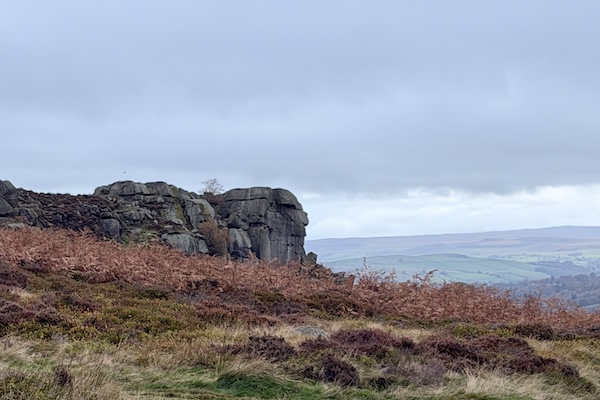
Sarah Wilson: This is the Roots and All podcast, and I’m your host, Sarah Wilson. Join me as I talk about all aspects of gardening with some of the top horticulturists from around the world. Following a few recent literary-themed episodes,this week I’m joined by Amy King, author of The Brontë Botany, to explore the relationship between the Brontë sisters and the natural world. Released hot on the heels of my own trip to Haworth, where I walked the moors and visited the village, we look at how plants and landscapes shaped the sisters’ writing, uncovering the botanical details and hidden meanings woven into their novels.
Amy King: I’m an English professor and a Victorianist, um, with a specialty in 19th-century British lit, so I teach the Brontës all the time. And um, and, and love their work. And I’ve been reading them since I was really like a teenager, but up through, you know, my professional capacity. And then um, I guess, I guess one answer would be, you know, to go to the biographical, which is that um, you know, I do history of science and literature and especially botany and literature. I have several academic books. And then after the pandemic, I was, I was at Kew Gardens doing research, and after London I was like, “Let’s, let’s get up north. I’ve, I’ve actually never been.” So we went up to Newcastle and then rented a car and drove down through the Pennines and um, ended up being in the Northern Yorkshire Dales National Park in the Swaledale Valley. And um, I don’t know, it was just, you know, we were all so giddy right after the pandemic kind of ended and they,and they let us travel. And um, just really enjoyed the spring bloom um, so much. And I’d never actually written about the Brontës, and I’d been looking for like a more of a popular kind of book, you know, I’d written several academic books and you know, only so many people read them and I was thinking I’d really love to write about the Brontës. And um, and then like just like a went home, nothing happened, and then a couple of years later I just got an email out of the blue from Riverside Press saying they had found my work and they wanted to do a book about the Brontës and botany and would I want to do it. So that’s the answer, really. It’s a great opportunity. It was very serendipitous.
Sarah Wilson: Yeah, and I just got back from Haworth and I didn’t make it to the parsonage because the place was mobbed. And I believe you’ve also been, but you also didn’t make it to the parsonage.
Amy King: Right, right. So we were in the Swaledale Valley and you know, I was really not on a literary pilgrimage that trip. I was really more on a pilgrimage about the landscape. It was May of 2022. You know, I grew up reading the Brontës and then reading like say The Secret Garden and having this almost kind of imaginative relationship to that landscape, but as an American just I hadn’t been. I had lived in London, but never, never had been north. And so um, the intention was to get to Haworth and to the parsonage museum. Um, but uh, my husband got a concussion, hit his head on a, a stone wall at this house we were staying in. And um, so we, we just kind of stayed put. And so um, I’ll, I’ll get to the, the parsonage museum soon, I hope. But um, but yeah, my, my understanding of the Brontës is, you know, as an academic I’ve, you know, I’ve just studied them and written about them for years.
Sarah Wilson: Yeah, I mean that’s the curse of staying in historic English houses, uh, the, the low ceilings. They’ve caught many people out. Yeah.
Amy King: They’re a real hazard.
Sarah Wilson: And, and I was going to ask you about the parsonage garden itself because obviously it was important to them at the time, but I think they’ve still kept a lot of the species that would have been present in the Brontës’ times,haven’t they?
Amy King: Yes. I mean, I’m really indebted to some research done by a former horticulturist and gardener there, uh,Emma Emerson, you know, wrote an article about the reconstruction of the garden there. So there was no, you know, plan or any kind of design, so they were kind of making a lot of um, you know, guesses about um, you know, what plants would, would be there. And, and she um, reconstructed that garden as it would have been like say prior to 1861 when the father died, and so you know, it’s, it’s a pretty simple garden. There’s like hollyhock and sea thrift and marigold and crocus and cornflower. And um, and they’ve reconstructed it. Um, but again, without that formal design, it’s a lot of conjecture um, in a certain way.
Sarah Wilson: Yeah, and I guess it’s not the easiest spot to garden either. You know, having been up there this weekend, it was very chilly, it was very blowy, and obviously, you know, we’ve got Wuthering Heights, it’s kind of noted for its quite bleak, quite testing atmosphere. So I guess the garden, even back in the day and now, it would have been very much at the mercy of the elements.
Amy King: Yeah, absolutely. And then at the same time I, I wouldn’t want to like press that too hard because there’s a certain mythology about the Brontë sisters that was kind of developed by Charlotte and then also by her first biographer,Elizabeth Gaskell, who, who really tried to like create this like image of the Brontës um, as, as uh, you know, living in this really wild, out-of-the-way place, a really a place inhospitable to plants. And, you know, uh, Gaskell wrote, you know, it’s a place where neither flowers nor vegetables would flourish. And there’s a certain sense that um, there’s like a mythology being built up. There’s a whole book written about this by Lucasta Miller called, you know, The Brontë Myth.So um, you know, it’s, it’s a, it’s a mistake to think that there aren’t plants. They’re just, you know, they’re not showy cultivated garden plants we might get down south, but um, they certainly knew the natural world um, by studying it and by painting it and by taking walks on the moors. And it’s just a different range of reference than we might get from like a more cultivated garden.
Sarah Wilson: Obviously, because you’re a literary teacher, you’re looking at symbolism in the books. Is that what led you to, to write the book? Did you just kind of see this rich vein of symbolism throughout that linked back to nature and gardens?
Amy King: Well, I mean there’s a, a longer story in that in that like my first book was about Linnaeus’s taxonomy in the 19th-century novel and then I’ve written a book about like kind of pre-Darwinian natural history in the novel. So I have this interest in in botany and natural history and the way it intersects with literature, so it can, it can do so in pretty complex ways, not always just symbolically. Um, and I have a kind of biographical interest in plants, which I can talk about if you want later, but um, but I mean I guess the main thing to say is that the sisters use plants in different ways.They’re not, you know, they uh, Emily Brontë, you know, her one novel Wuthering Heights is much more, you know,using it in a more symbolic um, kind of way. There’s the uh, you know, the, the two houses that are there, um, one represents culture and one represents nature. And so, but in like Jane Eyre, for instance, um, the references are both symbolic and then also in the service of the novel’s realism. Um, so yeah, I mean there’s just a lot of plants in the novels.Um, oh, and I would just also say that the other sister, Agnes, the one who’s less, I mean um, Anne, the one who’s less well-known, um, uses that Victorian language of flowers, the floriography. It’s part of like the plot of the novel. So um, it’s all to say that like depending on the plant and depending on the person doing the writing, the plant is used in different ways.
Sarah Wilson: Yeah, and the floriography really interested me. Was it just Anne that used it and I guess it was so common at the time for people to ascribe a meaning to a flower and then give it to someone? But can you go into that a little bit more deeply?
Amy King: Yeah, sure. So um, Anne in particular used floriography. In The Tenant of Wildfell Hall, the, the two um, main characters really can’t like be open about their, you know, attraction to each other for various plot reasons. She’s still married and um, so they use this kind of elaborate floriography to kind of talk to each other, which people at the time would have completely understood. Um, you give this particular flower, it means a certain thing. Um, so, but Anne was just as likely to, you know, like in her novel Agnes Grey, she, she depicts seaweeds, which is some of the plants I explore,and she’s really specific um, botanically precise about like this, you know, she, she evokes the tangled seaweed, she evokes, there, it’s very clear that some of the seaweeds are in the tidal zone, she’s very clear about the timing of when the walk is happening and so on. So her references can, can touch floriography, but she also is using them in a really realistic way as well. And she went to Scarborough and spent a lot of time. It was her favorite place.
Sarah Wilson: So I’m guessing they were like really well versed in botany as well. Would that have been part of their education?
Amy King: Absolutely. So they were like by all accounts like personally indifferent kind of gardeners, but, but um, but they certainly knew plants like most educated Victorian women. Um, you know, the amateur study of, of nature um, and especially plants for girls was considered like productive and like morally elevating kind of use of one’s time. Um, and um, and certainly we know from like the father’s library that they had access to certain periodicals and certain botanical books. Um, they lived during a time which has been called the heyday of natural history. So you know, they were and they certainly had like a deeply informed like experience of being like out in nature and knowing plants. We know that when,when Charlotte Brontë married late in life, one of the ways she marked the occasion was to plant two um, fir trees at the church, and on her honeymoon she collected ferns because she was a collector of ferns, so she pressed them in her book.So we do know that, that the, that they all um, cared about plants in, in various ways. And um, and that would have been pretty typical for women at that time.
Sarah Wilson: And you mentioned that they all used plants in different ways within their writing, but did they share a common lexicon of plants and did that tie into the worlds that they constructed? Because I found that really fascinating that they had kind of created these worlds between them, but that there’s not that much documented evidence about those.So I’d love to kind of get your take on that.
Amy King: Yeah, sure. They’re referring to plants that are just native in that landscape, like, like heather and heath and bluebells and you know, they all would for instance make reference to um, primroses and uh, violets, bluebells, heather.Um, these are all like, you know, just you know, common or like bilberries, right? Like bilberries, whortleberries are in all the novels, right? Um, um, thorns are, you know, like the hawthorn tree or blackthorn are, are referenced by all of them.Um, and then they use them in different ways, but there is a common like kind of um, I don’t know, plant like uh,vocabulary that they’re all using. And but again in different, different kinds of ways. So for instance, like Charlotte Brontë in Jane Eyre at the opening is um, she’s a little girl, if you know the novel, and she’s locked in this, in this room by her,her nasty aunt, and she looks in the mirror and she sees like an imp in the background and there’s this wonderful quote like a, like a fairy, and she’s gets really freaked out because she’s like she’s imagining that there’s a fairy in a ferny dell and there’s all these references to ferns that kind of like um, reference the supernatural the way she feels. By the end of the novel, you know, when she finds goes back to Mr. Rochester, the name of the house is Ferndean, you know, and there’s lots of references to bracken and ferns in a more um, realistic or uh, way in other parts of the novel. So a lot going on with ferns, for instance, and um, um, for her, and then Emily Brontë like refers to bracken, you know, all the time, so kind of more vernacular terms that she uses.
Sarah Wilson: And they all use it like you said in different ways. So I’ve made a note that says that plants and the landscapes are used, I think it’s fair to say, to one, set the tone; two, describe people; and three, to hint at future events. I mean, there may well be other meanings, but do you think that’s a fair assessment and who uses them in what way?
Amy King: So just to give you an example, like Emily Brontë in her famous novel Wuthering Heights refers to Heathcliff, the main character, in warning off another woman about marrying him, Isabella. She calls him he’s full of firs and whinstone. So firs being a reference to, you know, prickly, prickly gorse, and um, whinstone to like a hard rock. And then of course his name, of course, Heathcliff, right? Um, so there’s just ways that she’s using plants to like help us illuminate the character of, of Heathcliff. Um, you know, it depends on the example, but um, see if I can think of like another one, like um, in Wuthering Heights just to go to give you another example from that novel, which people are very into right now because of the film adaptation. But um, the house is described on the first page as having a few stunted firs at the end of the house and a range of gaunt thorns. And um, you know, it’s strange to think of the fir because you’re like,why is why is it a fir like, right? Because you know, um, and so I had to kind of conjecture because the Douglas fir doesn’t get introduced into England until the 1820s and the novel’s set back in 1801. So my sense is, you know, and this is where the, what the book is trying to do, it’s a reference to Scots fir trees or uh, Pinus sylvestris, right? They had drawn a fir tree in Belgium, so they’d seen firs, but you know, she’s, she’s wanting to locate it in place. So the fir is a, a colloquial term um,and um, you know, it’s a our narrator at that time, Lockwood, probably wouldn’t understand the difference. He was kind of misnaming it, I guess is a way to say it. And it becomes a really important part of the plot because when Lockwood, our narrator in that opening chapter, stays overnight in the house, um, he’s kept awake by what he feels like is a fir bough um,scratching against the window. And he gets so irritated by that he breaks the glass and reaches out to grab the fir branch and it turns out to be the ghost of Cathy who grabs his hand and says, “Let me in, let me in.” And then he like very violently rubs the ghost hand against the glass and it bleeds all over. So you know, this the plant there, the fir, you think,oh, it’s just a small detail, but it ends up being really central to the way the novel is establishing that supernatural or gothic element of, of like, what kind of plant can survive on this weathering, you know, upland landscape? It’s the Scots pine um,or it’s a ghost.
Sarah Wilson: One of the other sort of specific plants that you talk about is mahogany and that’s got really good significance, hasn’t it?
Amy King: Yeah, well it’s and maybe unexpected to readers because you, you know, mahogany of course is not native to England, but there’s all these references to mahogany in um, in the scene in the red-room in Jane Eyre where she’s locked by her, this her aunt, and it’s, it’s called the red-room because there’s, you know, red velvet curtains and very red dark furniture. It’s the, it’s the death chamber of her uncle. And um, she gets locked in there as punishment and she feels very oppressed and she actually calls herself it’s like she’s being treated like a slave. So to me, the references to the mahogany furniture there I think meant, you know, if she’s writing this, it’s after the emancipation of slaves in the West Indies, but it’s still like a very, you know, reference I think people would have understood that the mahogany is almost like a metaphor for slavery, right? Because the mahogany was, was cut down in Jamaica by English colonists by slaves. Um, so that’s one of the perhaps more surprising references to plants.
Sarah Wilson: Yeah, it was surprising. And another one that obviously is very common in the landscape was the oak,which again is, is kind of very much used as a symbol. And can you talk a bit about that?
Amy King: Oh sure. Yeah. So, you know, if there’s like one tree that is like a metonymy for England, right? It’s like Quercus, right? It’s the oak is that strong um, tree and um, and yet when I write about it, read about like there’s all these references to the oak furniture in Wuthering Heights and um, you know, oaks wouldn’t wouldn’t survive at that level up there in that in, in that kind of uh, atmosphere. So they would have had to found the oak, you know, in a lower, you know,and so the oak furniture they have is is kind of signifies the um, the occupants of Wuthering Heights that they’re an old and ancient family that um, that you know, they had they’ve had money. It’s a kind of a way of establishing class. So that’s, that’s part of the reference for me is to the oak is to the kind of class background of the inhabitants of Wuthering Heights.
Sarah Wilson: And what class were the Brontës actually out of interest?
Amy King: Well, so they’re the daughters of uh, a clergyman. So um, you know, while he lived, um, they would of course been living kind of an upper middle class life, uh, or middle class life, I guess I would say. Um, but they all were kind of,you know, expected to, you know, if not were expected to marry and um, and if they weren’t interested or did not, they had to kind of go out and work and they did as, as governesses. Two of the older sisters died of tuberculosis and of course they all, except for Charlotte, ended up dying of tuberculosis because they’re living in this kind of, you know, not Haworth was a, you know, environmentally degraded and like, you know, difficult um, very low life expectancy in that area. And so they too, even though they were of the more, you know, um, they weren’t gentry certainly, but they were adjacent to them, I guess is the way that historians describe it because the father was a clergyman, they um, you know, they were subject to the, the kind of illnesses that were abroad at that moment and that’s why they die so young. They all died of tuberculosis except for Charlotte. She only makes it to 38.
Sarah Wilson: And they had quite interesting journeys as well, didn’t they, overseas, which and did that feed into their knowledge of plants?
Amy King: It does. So um, Charlotte and Emily um, go abroad to work at a school in Brussels. And um, it doesn’t stick for Emily. She’s really desperately homesick and so kind of at the first opportunity goes home and then kind of refuses to go back. Charlotte on the other hand really liked being in Brussels and her novel Villette is commonly thought to kind of uh, to be based on kind of her experiences working uh, working there. And uh, so when you get to the chapter in The Brontë Botany about Villette, you’ll see that the references to plants are quite different because we’re, you know, we’re we’re suddenly in a um, you know, in a uh, a boarding house schoolhouse in the, in the center of Brussels. And uh, and the plants that are growing there and the plants that they’re exchanging with each other and so on have different um, different purposes. When, when they were there they did um, as I said I think I mentioned before, they sketched a fir tree, which would have been new to them. And Charlotte more generally was very interested in botanical painting and if you go to the parsonage museum, there’s a number of her um, paintings of, of flowers, which were again, very common pastime for, for girls at that age, but she was a pretty good painter. I mean, she paints uh, morning glories and violets and roses and a number of things.
Sarah Wilson: And you know, obviously Anne was using floriography, she may have leaned more into dealing with ornamental plants, whereas Emily, for example, is noted for her use of, you know, the wild landscapes and kind of the descriptions of those. Do you think Emily leaned towards a sort of more gothic use of plants?
Amy King: Yeah, absolutely. You know, and as I mentioned before, she uses seaweeds, but she’s, you know, she’s making distinctions between like hybridized primroses and wild primroses and um, she talks about uh, you know, the Christmas rose and she’s yeah, it’s just much more um, cultivated plants. And, and Charlotte as well, like if you’re in reading Jane Eyre and you’re in the scene at Lowood, which is the school, um, tuberculosis is is taken over the school and Jane is mercifully free from it, so she’s outside in the springtime and there’s really, you know, very um, deep references to to cultivated plants like snowdrops, I’m just going to read here, snowdrops and crocuses and purple auriculas and golden-eyed pansies. Um, and so there’s, you know, there’s specific references to like vernacular names of plants in the novel.
Sarah Wilson: I thought the tree was really interesting as a sort of continuing thread throughout Jane Eyre.
Amy King: Uh, the chestnut tree? Mhm. Yeah. So um, if readers remember um, when Jane is with Mr. Rochester and they’re out in the garden and it’s midsummer and it’s, it’s, it’s midnight when she really shouldn’t be out in the garden with a man with whom she is not married and it’s her employer. Of course, she has a crush on him and so it’s, it’s, it’s midsummer and uh, they’re walking and she smells the scent of his cigar and there’s also the scent of the roses. So it’s, you know, it’s almost like over-the-top kind of um, symbolic um, heaps of the flowers and the cigar like as a phallic symbol.Um, she tries to sneak away, but he knows she’s there. And um, and they end up wandering down to a lower garden where the chestnut tree is. And that’s where they kind of um, acknowledge to each other that they um, have romantic and sexual feelings for each other and they kiss under the horse chestnut tree. And then she, she later that night uh, a storm comes in and the chestnut tree is uh, struck by lightning. Um, and they’re engaged at this point, but this the chestnut tree being struck by lightning and falling, of course, is a pretty, pretty clear indicator that um, that things are going to go awry with their engagement and of course they do shortly thereafter.
Sarah Wilson: Now I have to ask the question, do you have a favorite Brontë and do you have a favorite novel?
Amy King: Oh, oh no. I think I probably ultimately Jane Eyre is the one that kind of comes comes back to me um, and which I can reread and find new things in all the time. Um, I admire Wuthering Heights a great deal and I have a new appreciation for Agnes Grey in particular after writing this book, but um, I think it’s Jane Eyre for me.
Sarah Wilson: Yeah, actually out of all of them, I really did fancy reading The Tenant of Wildfell Hall actually after reading your book.
Amy King: Good, yeah, yeah, Anne deserves to be better known. She was writing, you know, problem fiction and she’s a feminist in her own right.
Sarah Wilson: The other thing I didn’t realize from reading it was the amount of poetry that Emily had written.
Amy King: Yes, so the first thing that the three sisters wrote was a poetry book that only sold like two or three copies, but um, uh, so our knowledge of Emily’s poems really come from us from recovering them in the 20th century. And when you go to read Emily’s poetry, you realize it’s really quite good. And there’s wonderful if anybody who’s um, oops, just dropped my headphones. Sorry. I said Emily’s poetry is really quite good. Um, and uh, it’s worth looking up, especially her poems about um, I particularly like about bluebells and uh, she and harebells and uh, let’s see if I can find some. Um,yeah, she’s uh, “To the Bluebell” is I think one of the more beautiful poems in the English language um, especially if you like bluebells.
Sarah Wilson: So do you think you will study anybody else in terms of their use of botany within their writing?
Amy King: Well, you know, I wrote a book um, which was my dissertation originally about Linnaeus and so botany has been a big part of my like academic research and you know, I’m not sure. At the moment I’m working on a book um,about Marianne North, who’s a, a great painter of the later 19th century and she’s she’s an incredible traveler. I don’t know if you’ve ever seen her paintings at Kew Gardens, but she has a permanent exhibit that she funded and you know, she went all over the world and painted the world’s um, uh, plants in situ. So instead of it just being on a white background, they’re actually in the landscape in which she finds them. And so they’re, they’re a great like kind of um, account of what the world looked like, you know, in the in the latter half of the 19th century and they’re they’re kind of amazing. So I know I’ll keep working on plants and literature and um, I’ve done it my whole life. So and that that comes in part for if, you know,from just my background. I, I grew up around um, people who were really invested in the natural world and my mother and father are going to be thrilled I’m on a gardening podcast because they uh, they were landscape designers um, and,and had a small landscape construction business and nursery and um, and you know, it was right out of our house and um,so I grew up around plants and I kind of learned about them through osmosis and from working in their business for, you know, for um, most of my college years and so on. And so um, plants are always a recurring passion of mine.
Sarah Wilson: Thanks to Amy for joining me to explore the fascinating botanical world of the Brontë sisters and the hidden meanings behind plants in their writing. If you enjoyed today’s episode, you might also like Episode 169, Darwin’s Garden with Dr. Jude Piesse, and Episode 245, The Language of Trees with Kate Holton. You’ll find links to both in the show notes. I’m delighted to say that this week’s episode is again brought to you by Meadowmania, British wildflower seed experts for over 60 years. If you’re stuck for a gift for the gardener in your life, have a look at their Christmas gift shop. It really is worth a look. They have a Hori Hori knife which digs, cuts weeds and plants, as well as a lovely gardening apron with pockets for everything. Nowacky tools and they’ve got loads more as well. And until November the 27th, 2026, you can get a wildflower collection box free of charge on gift orders over £50. Find them at meadowmania.co.uk. As always, thank you for listening. Next up is Benny with his insect of the week.
Benny: The sharp-collared furrow bee, scientific name Lasioglossum malachurum. So my insect of the week this week is a bee. I’m quite biased towards bees, but uh, I’m not going to apologize for that. This one is a cool, quite tricky to identify one, but I like its ecology and I think it’s quite a useful one to explain. So the etymology, Lasioglossum, the genus comes from Greek, lasios meaning kind of hairy, glossa, you know I know that one from plants is tongue, uh, hairy-tongued. The second word, the epithet, is also Greek, malachurum, coming from soft or gentle, um, malakos, not to be confused with Malacca. Um, and oura meaning tail, so like a soft tail referring to the abdomen, uh, and both aspects of that scientific name being Greek, named by the brilliant William Kirby in 1802, he named a lot of British bees. Uh, so this this species I think is really fascinating because when I kind of started to learn about bees and I started to learn that it wasn’t just a honeybee or just a honeybee and a bumblebee, you know, we’ve got roughly 24 species of bumblebee in the UK and Ireland alone, one species of honeybee, and then the majority are solitary beyond that. So when I started to learn about Lasioglossum and Halictus species, they’re known as halictids in the Halictidae family, quite a few species overall, and quite a lot of them are eusocial, so they’re not entirely solitary. So we’ve got kind of fully social bees like bumblebees and honeybees have got like a colony with lots of workers, typically one queen, and then solitary bees with the female just working on her own, provisioning for her young in a, you know, a burrow or a cavity, laying eggs and just putting pollen in on her own. But we’ve got these groups in the middle that are eusocial, so they’re kind of their strategy is in between a social bee and a solitary bee. And the Lasioglossum and Halictus bees find themselves in that bracket. So they can even have multiple queens within a colony. You can have these big aggregations of them and you have these networks of um,cells, nest cells, and they’re acting with workers and multiple queens often as well, which is very, very interesting. They can have an extremely long season, can be kind of perennial in a way as well. Whereas most solitary bees are annual species, everything in that nest, all the adult and the males that have come out would have died by the end of the season and their young will be developing in the ground, where- whereas the eusocial species you may have overwintering. And bumblebees, you’ll have just impregnated queens that will be trying to overwinter ready to start new colonies the following year and then honeybees can be very perennial, lasting for many years provided their colony is sound and healthy. So Lasioglossum malachurum, the really interesting thing about this bee, not just the common name being sharp-collared furrow bee, that made it John Little’s favorite bee. Um, so the bee has got typically these really angled shoulders,they’re called pronotal collar or pronotum is these kind of shoulder points just behind the bee’s head. And this species has got a very right-angled sharp pronotum or pronotal collar, so that’s where it gets the common name, the sharp-collared furrow bee, which is quite cool. If you look at it at a glance it’s quite a small species, really not very big. I think the wing length is something like five to six and a half millimeters, so they’re really quite small. Um, they nest in clay, so that’s the really interesting bit. So there are quite a lot of species, the most species I come across will nest in loam, kind of sunny loam, quite a few species nest in sand as long as the sand’s got the clay content as well. And then there’s a portion of species that are nesting in clay. So obviously clay is very maligned in horticulture, everybody’s trying to improve clay, but bare clay or partially bare clay is very, very valuable, especially when it’s kind of partially vegetated. I think that’s the sweet spot, but you can get these big aggregations, you can get these on kind of farm tracks or paths or even the center of like kind of driveways that have got very clay-heavy material and you get these big aggregations of furrow bees on there in sunny bare clay. So I think that’s a really fascinating aspect that clay is their primary soil to nest in. Uh, so as you can gather, ground-nesting species used to be very scarce, still is quite scarce across Britain and Ireland, and they are generally just found in the south and the southeast of the country. I don’t know of any record in Ireland or Scotland, um,not even sure about Wales actually. But yeah, the southeast. So a really nice little species. It’s probably unlikely unless you’ve really gone deep into bees already that you would have seen one or know you’ve seen one. Uh, the females have got a little vertical line on the bottom of their abdomen called a rima and that tells you it’s a female halictid. So that’s quite a good little feature to look out for if you’re going to look next year. And uh, other than that, a kind of wide range of flowers they’ll use, not a specialist in that way. Their only specialization really is the, the bare clay, which is very useful.So I hope you see one. Um, if you have seen one, then send me a picture. And always record on iRecord or iNaturalist.
Sarah Wilson: You can download or listen to the podcast direct from the website rootsandall.co.uk. Please also check out my Patreon, where you can make a one-off donation or take out a monthly subscription to help support the podcast. Because if you enjoy the show, please help it continue. I also have a GoFundMe where you can make a one-off donation. Even a one-off donation of £1 helps, and I’ll be really grateful for your support. So please go to Patreon or GoFundMe and search for Roots and All podcast.